
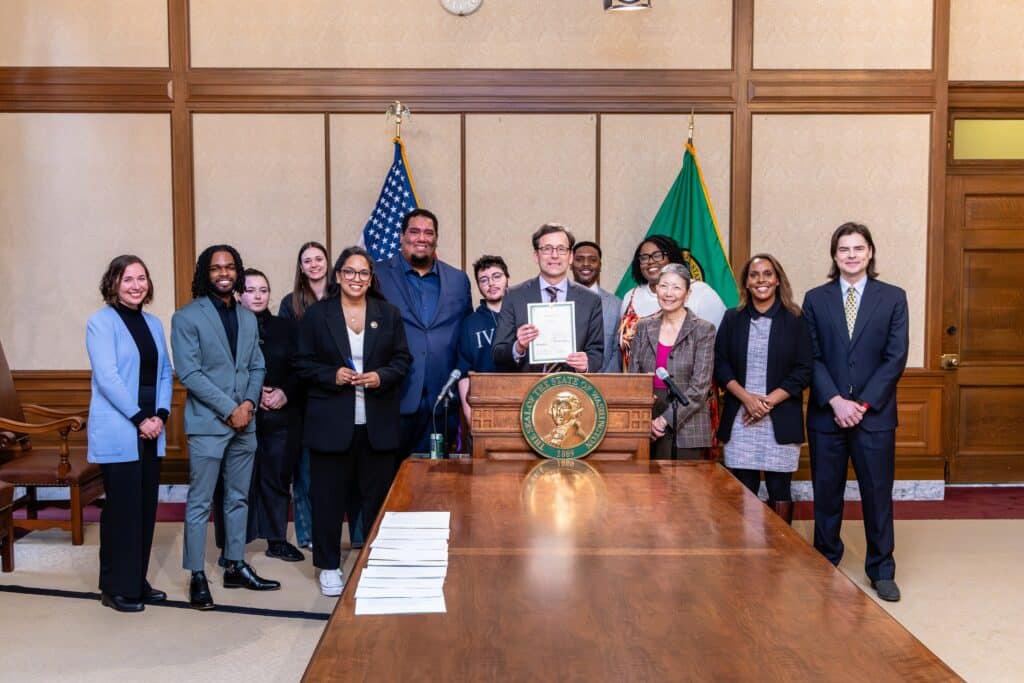
In a major step forward for students and families across Washington, SHB 2594 has officially passed the legislature and been signed into law by Governor Ferguson. Building Changes was proud to help lead this effort alongside partners across the state—demonstrating what’s possible when communities come together to shape systems that better support children, youth, and families.
When crisis hits, mobilizing our community of advocates fuels tangible change. Last summer, as federal funding for McKinney-Vento (MKV) came under threat—an already underfunded federal mandate that protects the educational rights of students experiencing homelessness—Building Changes convened partners across Washington State to understand the risks and chart a path forward.
Through our School/Housing Network—a Building Changes coalition of over 370 advocates who support homeless students and families across Washington—one message was clear: we must do all in our power to protect educational rights for unstably housed students.
Without critical services protected under MKV, like transportation and school stability, students are more likely to fall behind, disengage, or drop out entirely. Building Changes took action by bringing partners together, building on community expertise, and working with policymakers to develop a solution. Building Changes Director of Policy & External Affairs Aaron Yared connected with local and national policy leaders to discuss how to strategically fortify MKV protections in Washington. Inspired by other states such as Colorado and Maryland, we helped lead a coalition to codify MKV protections into Washington State law through SHB 2594—strengthening the foundation for a more stable, coordinated system of support.
Thanks to the people power of our coalition, more than 400 advocates signed in support of the bill during legislative session. After powerful testimony from school staff, nonprofit leaders, and Representative Sharon Tomiko Santos and bill sponsor Representative Kristine Reeves, the bill moved forward with overwhelming support.
We are deeply grateful for every single advocate who took action and spoke up for our students. We’d also like to thank our partners at Seattle/King County Coalition on Homelessness, WA Coalition for Homeless Youth Advocacy, Southeast Seattle Education Coalition, Supporting Partners in Education and Beyond, Choose 180, and the South King County Discipline Coalition for mobilizing their networks to support this critical legislation.
“I’ve worked with homeless students who fled abusive homes and are now sleeping behind abandoned buildings, students who fled domestic violence with their families and are struggling to find affordable rent as they live in their cars, students with disabilities who experience a lack of vital health services due to their homelessness. When students do not have a consistent, safe home, students face disproportionate challenges in attendance, academic achievement, discipline, and graduation rates due to their needs for stable food, shelter, and support going unmet, and we know that if we don’t support unhoused young people now, the likelihood of them being chronically homeless as adults skyrockets. If we don’t want adult homelessness to rise in the future, we must protect the educational rights of students during their crucial developmental years,”
–– Social worker in King County
Stories like these underscore why this work matters—and why prevention must be at the center of how we respond.
With the signing of SHB 2594 into state law, Washington has taken an important step toward creating more stable, predictable supports for students experiencing homelessness.
At Building Changes, this is the work we are committed to—advancing community-driven solutions, advocating for smarter policies, and partnering across sectors to build systems that prevent homelessness before it starts.
This progress reflects what’s possible when we listen to communities, work together, and stay focused on long-term change. And while this is a moment to celebrate, it is also a reminder: there is more work ahead to ensure every student, in every community, has access to the stability and opportunity they deserve.


